Questions we hear most often.
We have tried to answer the questions that come up most in early conversations — about who we are, how we work, what we build with, and what it costs. If something is missing, get in touch.
Who we are and what we do.
What is Auerbach Architecture?
Auerbach Architecture is a residential and commercial design practice based in Lincoln, Massachusetts. We specialize in nature-integrated architecture, historic preservation, and the use of traditional biogenic building materials. Our work spans new construction, additions, and the careful restoration of historic structures. The practice works in Lincoln and Concord, on Martha's Vineyard and Cape Cod, in Boston and greater Boston, and in Maine, Vermont, Montana, and California.
Where is Auerbach Architecture located?
Our office is at 25 Lincoln Road in Lincoln, Massachusetts — the Lincoln Old Town Hall, a civic building completed in 1848. We work from the second floor, the original meeting rooms. We work in Lincoln and Concord, on Martha's Vineyard and Cape Cod, in Boston and greater Boston, and in Maine, Vermont, Montana, and California.
What areas does Auerbach Architecture serve?
Auerbach Architecture is based in Lincoln, Massachusetts. We work in Lincoln and Concord, on Martha's Vineyard and Cape Cod, in Boston and greater Boston, and in Maine, Vermont, Montana, and California. We work alongside local builders.
Who are the architects at Auerbach Architecture?
The practice is led by Zander Auerbach (Harvard, AIA, RA). The team also includes Rodrigo Novelo Pastrana (UCL, formerly Buro Happold) and designer Kate Vitvitskaia. Prior practices include Maryann Thompson Architects and the MIT Media Lab.
What types of projects does Auerbach Architecture take on?
We primarily work on residential projects — new homes, additions, renovations, and the careful expansion or restoration of historic structures. We also take on select museum and commercial commissions. Our projects range from compact, disciplined houses to multi-structure family compounds.
Has Auerbach Architecture received any press recognition?
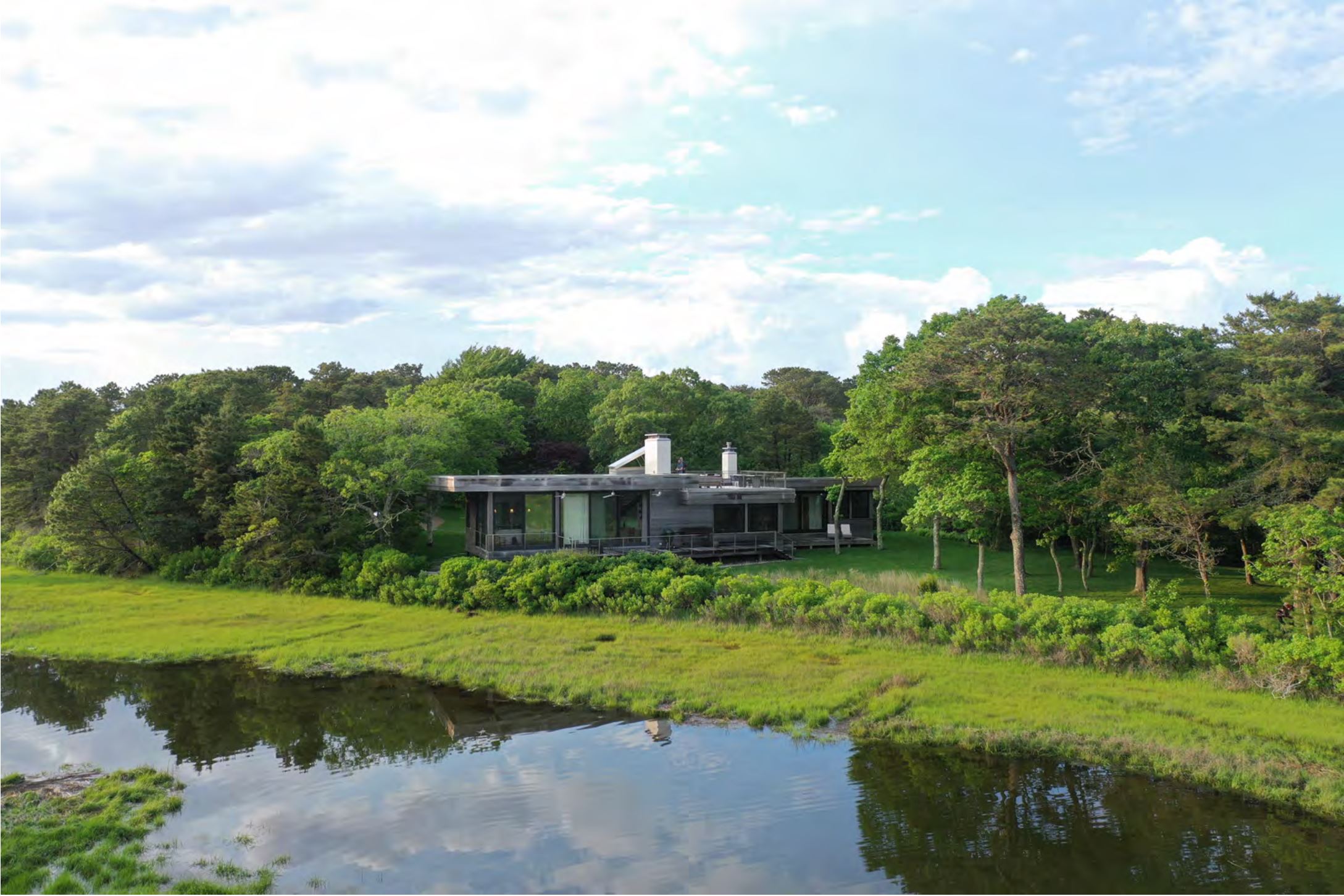
Yes. Pond House, a residence on Chappaquiddick, Martha's Vineyard, was designed by Zander Auerbach with Maryann Thompson Architects. Architectural Record published it in November 2024 as Egret Meadow House, House of the Month.
From first conversation to certificate of occupancy.
What is the process for starting a project with an architect?
It begins with a conversation. We want to understand your site, your program, and what drew you to the land or the building in the first place. From there, we move through schematic design, design development, construction documents, bidding and contractor selection, and construction administration. We stay with the project through those stages.
How long does a residential architecture project take from design to completion?
A typical residential project takes 18 to 36 months from first meeting to occupancy. Design and documentation typically takes 6–12 months. Permitting varies by municipality — Martha's Vineyard and the Hamptons both have thorough review processes. Construction runs 9–15 months for most single-family projects.
At what stage should I hire an architect — before or after buying land?
Before, whenever possible. The site shapes the design — its topography, orientation, tree canopy, view corridors, zoning restrictions, and setbacks all determine what can be built and where. We have helped clients evaluate land before purchase, and in several cases identified constraints or opportunities that changed the decision.
Do you handle permitting and contractor coordination?
Yes, both. Our construction documents are prepared for permit submission, and we manage the permitting process with local building departments and, where applicable, historic commissions, conservation commissions, and design review boards. During construction, we provide regular site visits and serve as the client's advocate in the field.
Do you offer interior design services?
Yes. Interior design is integrated into our architectural practice. We specify materials, finishes, lighting, and built-in elements as part of the design process. For clients who want help with furniture and furnishings, we can provide that as well, or work alongside a dedicated interior designer of the client's choosing.
How and why we build the way we do.
What makes Auerbach Architecture's approach different?
Two things. First, we design from the landscape inward — the site's topography, tree canopy, solar orientation, and view corridors shape the building before the floor plan does. Second, we build with traditional biogenic materials — linseed paint, lime plaster, hempcrete, wool and straw insulation, locally sourced timber — rather than petroleum-derived products that tend to trap moisture.
What are biogenic building materials and why do you use them?
Biogenic materials are derived from living organisms: timber, straw, wool, hemp, and lime. They share a useful property — permeability to water vapor. Unlike many plastic-based materials, these assemblies allow moisture to enter and to leave. Walls that dry out easily last longer and help avoid moldy air. We use them so a house can be maintained, and so moisture is not trapped in the wall.
What is a breathable building envelope?
A breathable envelope is a wall, roof, or floor assembly that allows water vapor to pass through rather than trapping it. Moisture that gets in has a way to leave, so a small gap is less likely to become rot. A sealed assembly can hold that moisture in if the vapor barrier is incomplete.
Do you design energy-efficient, low-energy homes?
Yes. We design houses to use very little energy. We design for passive solar gain and passive cooling, with a well-insulated, carefully detailed shell that stops bulk water and air leaks. We use natural, breathable materials so walls can dry, and we pair them with modern systems. Energy recovery ventilation (ERV) is our standard for well-ventilated buildings, paired with makeup air for combustion appliances and pressure balancing. The goal is a house that is comfortable, healthy, and inexpensive to run, and that can be cared for over time.
Can you work on historic homes and additions?
Historic work is a core part of our practice. We have restored, expanded, and carefully modernized 18th and 19th-century structures throughout New England and New York. We apply the same material logic to historic work as to new construction: traditional materials compatible with the original fabric, breathable assemblies that will not trap moisture against old masonry or timber.
Healthy, light-filled homes.
What is a healthy home, and how does Auerbach Architecture design one?
A healthy home has clean indoor air, plenty of daylight, and materials that don't give off fumes or trap moisture. Auerbach Architecture, based in Lincoln, Massachusetts, designs healthy homes by combining natural, biogenic materials like lime plaster, wood fiber, and wool with modern systems such as energy recovery ventilation (ERV). Every house is also planned around the sun, so rooms are light-filled through the day.
Can a house built with natural materials also have modern ventilation like an ERV?
Yes. Energy recovery ventilation (ERV) is our standard for well-ventilated buildings, paired with makeup air for combustion appliances and pressure balancing. Auerbach Architecture pairs breathable, natural wall assemblies with that ventilation. The walls stop bulk water and bulk airflow but let water vapor pass, so they can dry. The ERV supplies filtered fresh air day and night and recovers heat from the outgoing air. The two work together.
Do you design healthy, light-filled homes on Martha's Vineyard?
Yes. Martha's Vineyard is one of Auerbach Architecture's main areas of work, with projects in Edgartown, Chappaquiddick, and West Tisbury. On the island we design for salt air, humidity, and freeze-thaw cycles with natural materials like untreated cedar and white oak, and we orient each house for daylight and shelter from the wind. We work alongside local builders.
Do you work on Cape Cod?
Yes. Auerbach Architecture designed Jericho Path, a completed home in Falmouth Heights, and takes on new homes and renovations across Cape Cod. The same approach applies there: breathable natural materials, modern ventilation, and houses planned for daylight and their coastal setting. We work alongside local builders.
Is there an architect for healthy homes near Concord and Lincoln, Massachusetts?
Auerbach Architecture's office is in the Lincoln Old Town Hall at 25 Lincoln Road in Lincoln, Massachusetts, next door to Concord. The firm designs new homes, additions, and historic renovations in Lincoln, Concord, and greater Boston using natural, breathable materials with modern ventilation, and has experience working with historic and conservation commissions. We work alongside local builders.
Do you design homes in the Boston area?
Yes. Auerbach Architecture works in greater Boston. Older buildings are a good fit for this approach, because lime plaster and other breathable materials are compatible with historic masonry and timber and won't trap moisture against them. We work alongside local builders.
How we approach cost.
How are architecture fees structured?
Fees are set by scope and phase. We do not charge for an initial conversation, and once we understand your project, we share a clear proposal that details the work, timeline, and cost for each design phase — from schematic design through construction administration. This way you know exactly what each stage involves before committing to the next one.
What happens after that first conversation?
We take time to understand your site, your vision, and the project scope. A site visit is part of this. Then we prepare a detailed proposal that outlines the phases ahead, what each phase delivers, and the fee for each. You can review it, ask questions, and make an informed decision about whether to move forward.
Can Auerbach Architecture work within a tighter budget?
Yes. A compact, well-organized plan is one way to keep a healthy building within reach. It costs less to build, less to heat and cool, and less to maintain. Pond House, designed with Maryann Thompson Architects, is 1,960 sq ft with 3.5 bedrooms and generous outdoor living. Runner Road's main house is 1,850 sq ft with a separate guest cottage of 530 sq ft. A smaller plan leaves room in the budget for materials that can be repaired.
Our markets and licensure.
Do you design homes on Martha's Vineyard?
Yes. Martha's Vineyard is one of our primary markets. Pond House, designed by Zander Auerbach with Maryann Thompson Architects and published by Architectural Record as Egret Meadow House, is on the Vineyard, and we have additional projects there. We are experienced with the Vineyard's permitting environment, Conservation District requirements, and the island's contractor relationships.
Can you design a home in the Hamptons?
Yes. We have completed Further Lane, a restoration in Amagansett, East Hampton. We are familiar with Hamptons zoning, Architectural Review Board processes, and the regional contractor market.
Where are you licensed to practice?
Zander Auerbach is a licensed architect in Massachusetts. We take on projects throughout New England and beyond.